A most delightful way to acquaint oneself with a new city is to embark on a leisurely walk. A Split walking tour provides an invaluable opportunity to familiarize oneself with the lay of the land and identify those locales that beckon for further investigation. Choose from any number of private or group tours or embark on a self-guided exploration, utilizing this modest itinerary as a compass.
To aid in your navigation and to ensure you do not miss a single enchanting detail, a convenient link to Google Maps is provided for each captivating stop. For those who wish to survey the entirety of this delightful itinerary before setting forth, here’s the full map.
This post contains affiliate links and I may earn a small commission when you make a purchase using the links at no additional cost to you.
Where to Start
Here’s more information about how to get to Split, getting around Split, where to stay, where to eat, and more information about what to expect.
Make your way to the Split Sign to officially start your Split, Croatia walking tour. The sign is conveniently located at the end of the Split Riva, near the train station, bus terminal, ferry port, and taxi drop-off area. The entire walk should take about an hour if you don’t make any extended stops.
1. Split Sign

What better way to announce one’s arrival in Split than a selfie with a sign?
After you’ve got your pictures, cross the street and keep going a little way until you start to see a bit of a market.
2. Green Market

The Pazar, a sprawling outdoor green market, lies just beyond the palace walls. It is a daily pilgrimage for locals who must brave the throngs to buy fresh fruits and vegetables.
Keeping in mind that the water is always south of you, head west until you find Hrvojeva Street which runs along the eastern wall of Diocletian’s Palace and follow it north to the Silver Gate.
3. Silver Gate

The Silver Gate, a mere vestige of its former grandeur, marks the eastern ingress to Diocletian’s Palace from the bustling green market. Time has not been kind to this once imposing structure, leaving behind only the skeletal remains of the entranceway, the arches of the elevated guard walkway, and two vacant niches where statues once stood. These remnants, sadly diminished, form a portion of the eastern palace wall.
Backtrack south along the outside of the palace wall until you reach Split Riva, then turn right to continue following the wall.
4. Split Riva

The Riva, Split’s living room is a perilous place, a treacherous promenade where the air is filled with scent of espresso and the cacophony of gossip, a dangerous concoction that can lure one into a web of intrigue and deceit.
Follow the Riva until you reach the Bronze Gate.
5. Bronze Gate
Originally a sea gate, the unassuming Bronze Gate provided a sneaky escape route for Diocletian. Today, it serves as a popular entry point for unsuspecting tourists, leading them into the labyrinthine streets of Diocletian’s Palace.
Built between 295 and 305 A.D. by the retiring Roman Emperor Diocletian, the palace is a haunting testament to the vanity and decadence of those who once ruled the world. Its imposing structure, now a UNESCO World Heritage Site, continues to cast a long shadow over the city, a constant reminder of the impermanence of power and the immortality of rats and cockroaches. Admission to Diocletian’s Palace is free and it is open at all times as it is essentially just an old Split neighborhood.
Enter the palace through the Brass Gate and follow the corridor that leads to Diocletian’s Cellars. Doorways to the left and right lead to a small museum of Roman relics, including remains of an ancient oil and wine press found in the cellars. Regular adult admission is €8.
6. Diocletian’s Cellars

Diocletian’s Cellars once served as a storage area for the Roman Emperor Diocletian’s vast wealth and until very recently, they were overrun by shops selling trinkets and other such nonsense. But now the massive dark rooms with barrel-vaulted ceilings have been cleared out and would be perfect for hiding any number of dreadful secrets, or perhaps a particularly large dragon or three.
Climb the stairs at the end of the cellars, leading to the Vestibule.
7. Vestibule

The Vestibule, a foreboding chamber, once served as a gateway to Diocletian’s private apartments. As you step into this ancient space, you can almost feel the weight of the Diocletian’s tyranny pressing down upon you. This circular room, with its ominous dome and decaying decorations, was designed to instill fear in those who dared to enter. The vast, echoing dome serves as a stage for the daily performance by professional klapa singers. These vocalists, recognized by UNESCO, offer a rather unique auditory experience.
From the Vestibule, keep heading north, down the steps to the Peristyle.
8. Peristyle

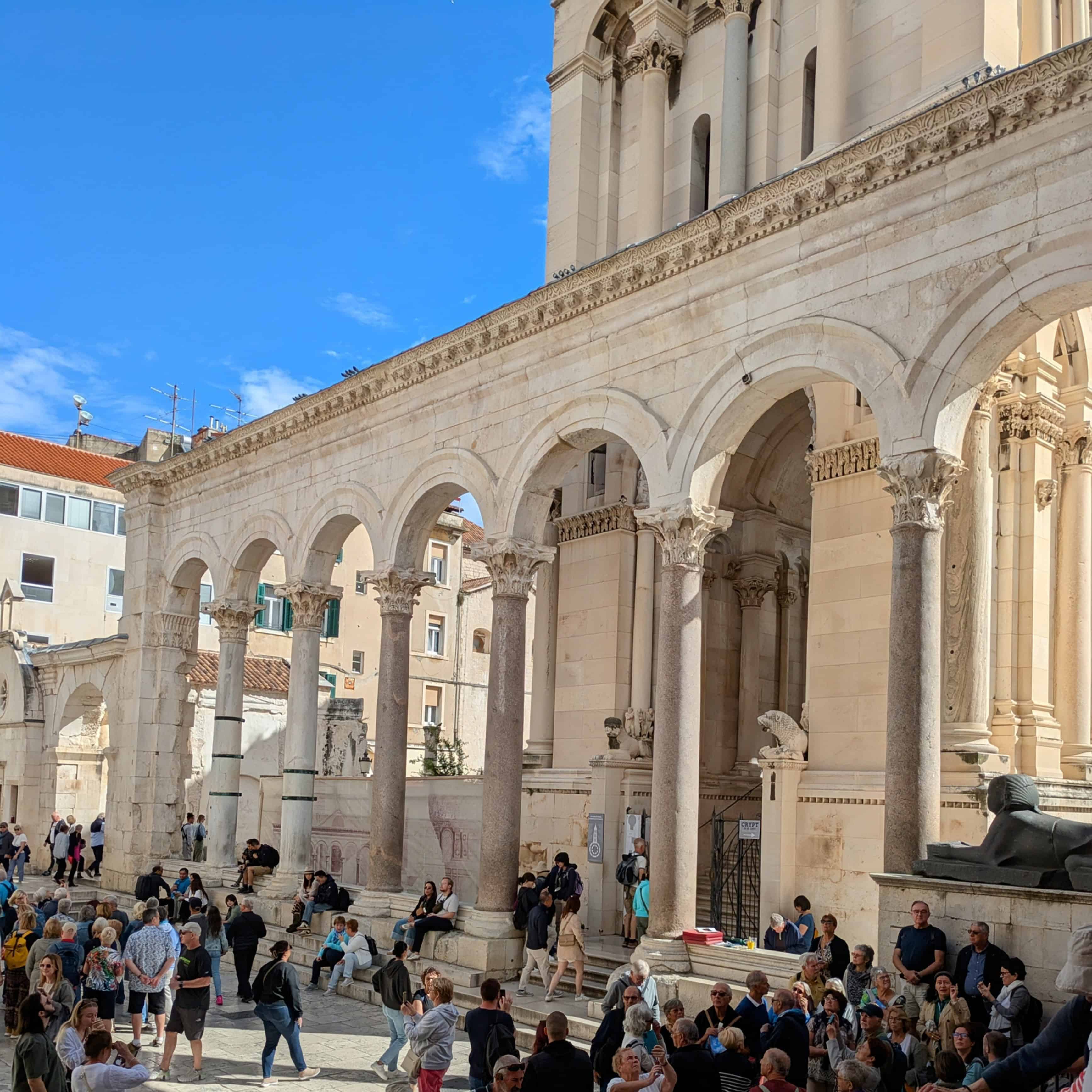
The Peristyle is the magnificent square at the heart of the palace, where the two main roads intersect. This once-grand courtyard is surrounded by imposing columns and a black granite sphinx that seems to watch over visitors.
On the Peristyle square, there is a ticket office for the cathedral, bell tower, Jupiter’s Temple, the cathedral treasury, and the crypt below the cathedral. Admission prices depend on what you want to visit, but range from €3 to €15. Opening times and quality of service here is inconsistent at best.
Take the stairs beside the sphinx to get to the Cathedral.
9. Saint Domnius Cathedral


The Cathedral of St. Domnius is a curious blend of the ancient and the sacred. Originally a mausoleum for the Roman Emperor Diocletian, it was later transformed into a cathedral in the 5th century, making it world’s oldest working Catholic cathedral that still has its original structure.
Its imposing bell tower, a gothic spire piercing the sky, offers a panoramic view of the city, a reward for those brave enough to ascend its steep and winding staircase.
Head back to the Peristyle and follow the road north to the Golden Gate.
- Hungry? Stop at Uje Restaurant, a charming tapas restaurant nestled in the heart of Split’s old town. Indulge in flavorful dishes served on rustic wooden boards and in vintage tinware. The menu features daily specials of warm dishes, along with a constant selection of cold cuts, marinated fish, and a variety of exquisite olive oils and wines.
- Need caffeine? D16 Coffee offers absolutely exquisite espresso drinks in a cozy space. They have a few pastries as well but the focus is definitely the coffee.
10. Golden Gate

The Golden Gate in the northern palace wall was the palace’s main entrance. Once adorned with statues of long-dead rulers, this gate now stands as a mere shadow of its former glory.
Head out the gate and up the stairs.
11. Monument to Gregory of Nin

Looming outside the Golden Gate stands a colossal bronze statue of Gregory of Nin. This imposing figure, crafted by the infamous sculptor Ivan Meštrović, is said to bring good luck to those who dare to touch its shiny, well-worn toe. Though one wonders what sort of twisted fate awaits those who dare to touch it.
Walk toward the bell tower.
12. The bell tower and the Chapel of the Holy Arnir
You may stumble upon the remnants of a dilapidated chapel, some stone remains in the grass, and a decaying Romanesque-Gothic bell tower, but one can hardly call this a site to behold. From what I gather, this is what remains of an 11th century convent, now reduced to mere rubble by the ravages of the Second World War. No, you cannot climb this bell tower.
Across the street, you’ll see the Museum of Fine Art.
13. Museum of Fine Art

From the grim shadows of the 14th century to the present day, the walls of this gallery are adorned with works that seem to whisper tales of sorrow and despair. Regular adult admission is €5.
Head back into Diocletian’s Palace through the Golden Gate and head back toward the Peristyle and make your way through the labyrinth of narrow alleys to Jupiter’s Temple.
14. Jupiter’s Temple

The Temple of Jupiter was once a place of pagan worship, now repurposed as a baptistery. A headless sphinx keeps watch over the entrance and offers great photo opportunities. Inside, the imposing figure of St. John the Baptist, another creation of the famous Ivan Meštrović, looms over visitors.
To the left of the Temple of Jupiter, the narrow, claustrophobic passageway known as Let Me Pass Street, is a cruel joke of a thoroughfare. Follow it if you have a sense of adventure, or backtrack to more efficiently navigate to the Iron Gate.
15. Iron Gate

The Iron Gate on the western wall of Diocletian’s Palace is the only gate that has remained in continuous use to this day.
Exit the palace through the Iron Gate and follow the path to a large plaza called People’s Square. Here, you’ll find Old Town Hall.
16. Old Town Hall

The Split Old Town Hall is a Gothic building that was erected in 1443. It is adorned with ornate windows and an attractive loggia. Though it no longer serves its original function, it has been repurposed as an exhibition space, offering weary travelers a touch of cool air.
Head to the far west end of People’s Square and turn left down Ul. Pavla Šubića to get to Fruit Square.
- Hungry? Make a quick detour to Zinfandel Food & Wine Bar, a chic wine bar with a contemporary design featuring large windows. The bar boasts an extensive wine list of over 100 international and Croatian labels, complemented by a selection of seasonal tapas and cold platters.
17. Marko Marulic Statue

The bronze statue at the center of Fruit Square is of Marko Marulic. Marko Marulic was a 15th century poet and humanist, often regarded as the father of Croatian literature His epic poem Judita was the first long poem in the Croatian language.
Turn around to see a pair of octagonal towers across Fruit Square.
18. Venetian Tower
It is said that these two octagonal towers connected by a wall are the sole remnants of a Venetian Castle erected in the fifteenth century. The larger of the two towers is known as the Venetian Tower. These two structures are now the property of the City Museum of Split but they are closed to the public so one can only imagine the horrors that may lurk within the thick walls.
From here, it’s easiest to make your way back south to the Riva, turn right, and follow the Riva until you reach Ul. Marmontova, and then turn right again. Just follow your nose.
- Hungry? Now would be a great time to grab a gelato at Ela’s Gelateria Artigianale, known for its delicious and high-quality artisanal gelato. They offer a wide variety of flavors, including classic favorites like chocolate, vanilla, and strawberry, as well as more unique flavors like basil, lavender, and arugula.
- Or try Corto Maltese Freestyle Food, a popular local hangout known for its cozy ambiance, friendly service, and generous portions of tasty food.
19. Sulphur Spa

The Art Nouveau Sulphur Spa was built in 1903 on top of sulphur springs and was used as a rehabilitation spa until recently. The springs have history of use dating back Roman times since it is claimed that they possess curative properties, offering relief for a variety of unfortunate ailments, particularly those afflicting the skin and the respiratory system. And it is claimed that these springs emit an odor so pungent and unpleasant that it effectively deters flies from the nearby fish market.
The fish market is located across the square.
20. Fishmarket

This labyrinth of slippery stalls and pungent odors is a daily ritual for the citizens of Split. Here, generations of fish mongers hawk their wares, their voices rising in a cacophony of bargaining and boasts.
The next and final stop is a ten minute walk out of the old town an up a hill.
- Hungry? If you need to replenish your stores before the final hike, head to Gourmet Bar Basta, a popular spot renowned for its authentic Neapolitan pizzas and stunning views of the Adriatic Sea. In addition to their pizza menu, Basta also offers a wide selection of cocktails, wines, and other beverages.
21. Viewpoint to Marjan

This picturesque vantage point overlooks the Adriatic Sea and the historic city of Split. Marjan is a sprawling sanctuary of serene nature that stretches across a peninsula west of the city center. The park is a labyrinth of winding paths and a chilling silence that can only mean one thing…
I’m sure you’ve enjoyed this Split walking tour. If you’re looking for more, here are all of my posts about Split and Croatia, including tips for planning your trip and essential Croatia travel experiences.


Leave a Reply