Borobudur is the world’s largest Buddhist temple and one of Indonesia’s most important cultural sites.
Read on to learn about Borobudur – how to visit, what to take with you, what to expect, where to stay, where to eat, and what else to do in the area.
This post contains affiliate links and I may earn a small commission when you make a purchase using the links at no additional cost to you.
What is Borobudur
This famous Buddhist temple, dating from the 8th and 9th centuries, is located in central Java. It is a large, squatty building that doesn’t look like much from the ground, but is fascinating as you start to climb.

It has survived a number of volcanic eruptions, earthquakes, and terrorist attacks over the years. Borobudur is about an hour by car from central Yogyakarta, and sits at the center of a number of traditional rice growing villages, surrounded by a jagged ring of volcanoes.
How to Visit
As of June 2023, admission for adults costs 25 USD or 45 USD for a combination Borobudur + Prambanan Temple ticket, both of which can be purchased online, and are valid for two days. These tickets will allow you to visit Tuesday through Sunday between 8:30am and 5:00pm. If you would like to go on Monday, the grounds are open, but you cannot climb the temple, which would not be worthwhile, IMO. Prior to the pandemic, there was the option to visit for sunrise or sunset, but as of yet, that has not been reintroduced. Tickets are assigned a specific time slot so the number of visitors at any given time is limited. For that reason, I do recommend buying online, even if it’s just a couple hours before arriving. You can buy tickets here or here (the second option costs a little more, but is a much more user friendly website, which may justify the cost). In addition to covering the entrance fee, a ticket also gets you a bottle of water, a guide (required), and a pair of fancy flip flops (required). They were not enforcing their rule requiring knees to be covered when we visited, but if they do, they will provide a free sarong or something as well.

I recommend exploring Borobudur as a day trip from Yogyakarta. The guided tour takes about an hour and a half. We hired a driver for the day and visited a number of other attractions before heading back to the city. Continue reading for suggestions of other things to see nearby.
If you would like to take public transit from Yogya, catch a 2A or 2B Trans Jogja bus to Jombor bus station. From Jombor bus station, take a local bus to Borobudur for 30,000 – 40,000 IDR. From the Borobudur Terminal you can continue to the temple on foot or ride a rickshaw or horse drawn carriage. It should take about an hour and a half in total. The last bus back to Yogya leaves Borobudur Terminal around 3pm.
Alternatively, you should be able to get a taxi, Gojek, or Grab to drive you the 45km for about 300,000 IDR / 20 USD.
Here are some tours you could book if you’d rather just let someone else handle the logistics. If you choose one that offers sunrise at Borobudur, ask questions to confirm. Also confirm whether the price of your tour covers the entrance fee.
Here’s everything else you need to know about visiting Yogyakarta.
It’s worth noting that after you visit, you have to pass through a pretty extensive craft and souvenir market on your way back to the parking lot so don’t think you’ve made a wrong turn.
What to Take With You
- Cash in IDR.
- Your ticket purchased online (here – cheaper or here – easier). You can also buy tickets at the gate, but be aware that there may be a long line and there is a limit to how many people are allowed in at a time.
- Water, though you will have no trouble buying more outside the temple and they will also provide you with a bottle when you enter the park.
- Bring sun screen and anything else you might need to be comfortable and safe in the sun. They recommend dressing in white.
- Make sure your phone or camera have plenty of charge because there are so many photo opportunities that you won’t want to miss out on. And you’ll likely waste a lot of pictures when someone steps into your perfectly framed shot just as you’re hitting the shutter button.
What to Expect
Borobudur is built in the style of Mandala which symbolizes the universe in Buddhist teaching. Borobudur was conceived as a Buddhist vision of the cosmos. Rising from a square base, it comprises a series of square terraces topped by three circular platforms, linked by four stairways that thread through carved gates to the summit. Working from the exterior to the interior, bottom to top, three zones of consciousness are represented, with the central, top sphere representing unconsciousness or Nirvana.
Zone 1: The phenomenal world, the world inhabited by common people.
Borobudur’s hidden Kamadhatu level consists of 160 reliefs depicting scenes of Karmawibhangga Sutra, the law of cause and effect. Illustrating the human behavior of desire, the reliefs depict robbing, killing, rape, torture and, defamation (which our guide repeatedly translated as “gossiping by women”).

A corner of the covering base has been permanently removed to allow visitors to see the hidden foot, and some of the reliefs. Photography of the entire collection of 160 reliefs is displayed at the Borobudur Museum which is within the Borobudur Archaeological Park.
Zone 2: The transitional sphere, humans are released from worldly matters.
The four square levels of Rapadhatu contain galleries of carved stone reliefs, as well as a chain of niches containing statues of Buddha (many of which no longer have heads).

In total there are 328 Buddha with 6 different hand positions on these levels. 1300 reliefs on these levels depict Sanskrit manuscripts, covering 2.5km. In addition there are 1212 decorative panels.

Zone 3: The highest sphere, the abode of the gods.
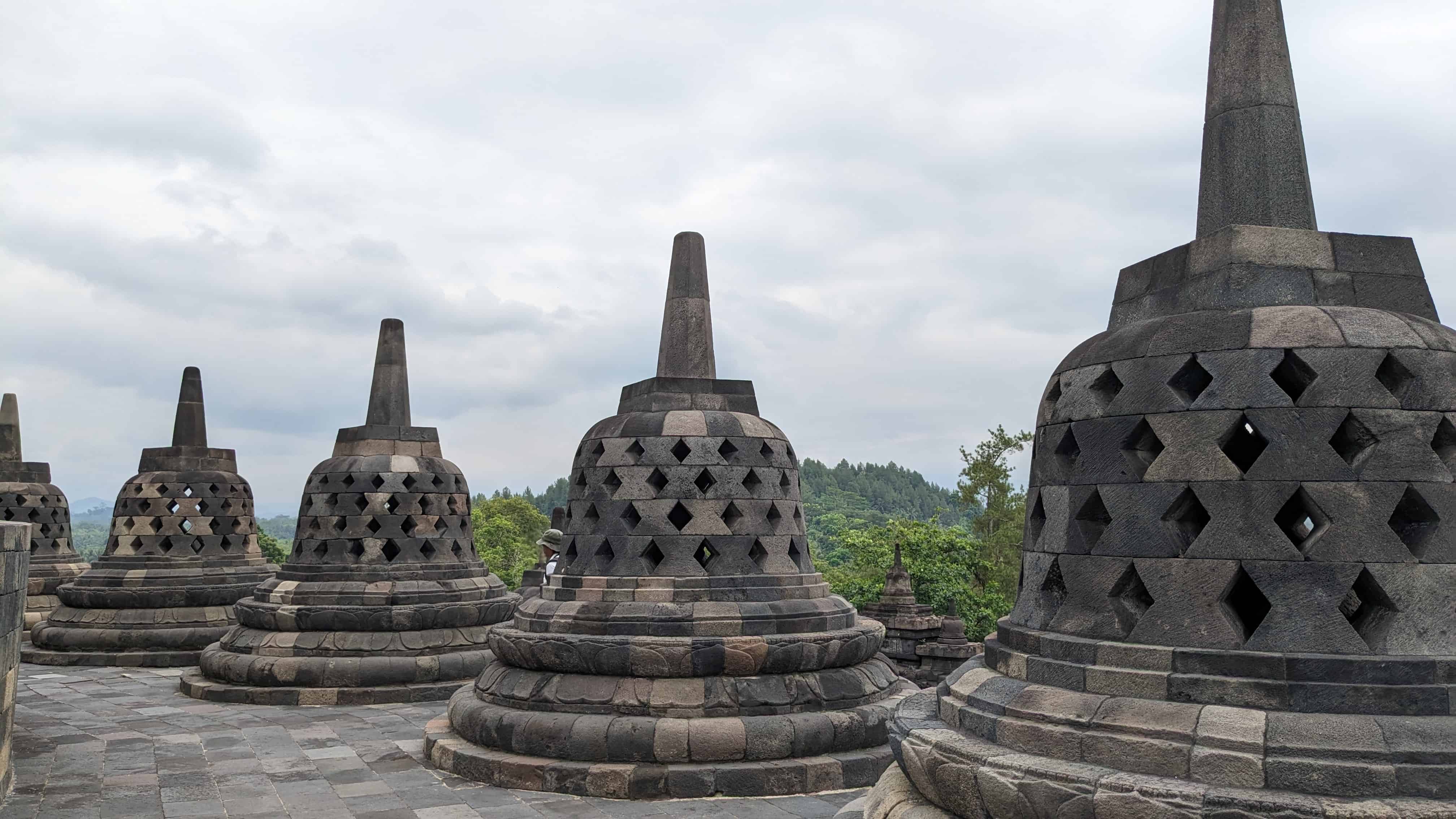
The three circular terraces leading to a central stupa represent the rising above the world. These terraces are substantially less ornate though no less magical.

The terraces contain circles of perforated stupas, each containing sculptures of Buddha facing outward from the temple. There are 72 of these stupas in total.

The impressive central stupa is slightly smaller now but originally stood 42m above ground level and the base is 9.9m in diameter. Unlike the stupas surrounding it, the central stupa is empty and conflicting reports suggest that it once contained relics, and other reports suggest it has always been empty.

Regardless of your beliefs, the view from the top is heavenly.

What Else to Do in and around Borobudur
Museums
Admission to Borobudur includes entrance to the Karmawibhangga Museum, featuring 4000 original stones and carvings from the temple, and the Borobudur Museum, with more relics, interesting photographs and gamelan performances at 9am and 3pm.
The Museum Kapal Samurrarska houses a full-size replica of an 8th-century spiceship, which was remarkably designed and built based on an image depicted in one of the panels that adorn Borobudur Temple. In 2003, the ship sailed to Madagascar and Ghana.
Other Temples
During the Borobudur restoration in the early 20th century, it was discovered that two smaller temples in the region, Pawon and Mendut, are positioned accurately in line with the Borobudur Temple. Pawon Temple is located 1.15 km from Borobudur while Mendut Temple is located 3 km from Borobudur. It is believed that there is mutual religious relationship between the three temples, although the exact ritual process remains a mystery.
- Mendut Temple: Look for a 3m high Buddha sitting Western-style and flanked by Bodhisattvas.
- Pawon Temple: This is reported to be the location where the ashes of King Indra of the Syalendra Dynasty are stored. King Indra ruled from 782-812 AD.


There is s 20,500 IDR (~1 USD) admission fee that covers entrance to both temples.
Villages
The villages around Borobudur each specialize in a particular cottage industry. For example, there is a village that specializes in making tofu, and another village the specializes in clay cooking vessels.
Here are some guided tours you can take to the villages: 1, 2, 3. I haven’t done any of these but did visit a farm, tofu factory, and basket factory near Prambanan as part of a bicycle tour and can say that it was a worthwhile experience.
Bukit Rhema
A large, 7-story interfaith prayer house that looks like a chicken. It was designed to look like a dove with a crown, but has been dubbed the “chicken church” for obvious reasons. Go for the novelty and stay for the views. There is s 25,000 IDR (~2 USD) admission fee that comes with a guided tour and taste of fried casava. It is possible to walk up the ridiculously steep and fairly long hill from the parking lot or you can pay an additional 15,000 IDR to ride in a “jeep” (back of a pickup truck).

Selogriyo Temple
Our driver suggested visiting a Hindu temple hidden beyond some rice terraces. It was about a one hour drive away to get to a small village with a single steep, narrow road. We then hiked about a mile uphill through beautiful rice terraces to get to the temple. There is s 50,000 IDR (~3 USD) admission fee charged at the start of the hiking trail.


Prambanan
It is very possible to visit Prambanan on the same day as Borobudur although we chose not to. It is approximately one hour away by car. Prambanan is an expansive, 9th-century Hindu temple complex (Indonesia’s largest) featuring structures with stone spires & sculptures. Visit some of the lesser known neighboring temples via bike rental, toy train, or golf cart shuttle. Tickets available online or at the gate. A combined ticket for Borobudur and Prambanan is available.

Where to Stay in Borobudur
I recommend visiting Borobudur as a day trip from Yogyakarta. Here are some places to stay in Yogyakarta.
That said, there are a number of rural homestays and guesthouses near Borobudur if you decide you’d like to spend the night.
Where to Eat in Borobudur
Check out one of the inexpensive warungs outside the temple entrance.




Leave a Reply