It is a curious truth that one of the most effective ways to truly understand the perplexing nature of a new city is to wander its streets at a pace that can only be described as leisurely, a pace that allows ample time for observations. A walking tour of Salvador de Bahía, therefore, presents an invaluable opportunity to acquaint oneself with the peculiar twists and turns of its geography.
One might embark on a self-guided exploration, using the following itinerary as a compass. And so to aid in your navigation and to ensure you do not miss a single enchanting detail, a convenient link to Google Maps is provided for each captivating stop.
This post contains affiliate links and I may earn a small commission when you make a purchase using the links at no additional cost to you.
Where to Start
Here’s more information about how to get to Salvador de Bahía, getting around, where to stay, where to eat, and more information about what to expect.
Now make your way to Largo do Pelourinho to officially start your Salvador de Bahía, Brazil walking tour. The entire walk should take a little over an hour if you don’t make any extended stops so I encourage you to at least visit the interior all of the free attractions to turn this into a half-day tour.
1. Largo do Pelourinho

This triangular cobblestone plaza, once a site for punishing enslaved people was transformed after the abolition of slavery in 1835. It fell into disrepair but was restored in the 1990s to its former glory so much so that it became the set of a Michael Jackson music video. Today, it stands as a vibrant symbol of Salvador’s resilience, where the shadows of the past are overshadowed by the lively atmosphere enjoyed by tourists and locals alike.
Take in the atmosphere for a few minutes before heading back down the hill to the far north end of the Pelourinho.
2. Escadaria do Passo (Manor Staircase)

This historic staircase connects Salvador’s lower city to its upper city. It’s renowned for its colonial architecture and the Igreja do Santíssimo Sacramento do Passo (Church of the Blessed Sacrament of the Pass) at the top of the stairs. The name “Passo” refers to the Stations of the Cross once depicted here.
Continue along the street – you’ll have the opportunity to climb down the stairs later, if that’s what you really want.
3. Igreja Nossa Senhora do Carmo de Salvador (Church of the Third Order of Mount Carmel)

Construction of this church began as early as 1630 and it’s renowned for its stunning Baroque architecture and deep historical ties to the Carmelite Order. Over the centuries, it underwent various phases of expansion and embellishment, resulting in a magnificent interior characterized by intricate altarpieces, ornate carvings, and particularly striking gilded (gold-leafed) woodcarvings.
Continue a little further up the hill until you reach an intersection and take a left to reach our next stop, or go right to find food and drinks.
- Hungry, thirsty, or hot? Continue up the hill into the neighborhood of Santo Antônio and stop in at Antique Bistrô – take a seat on the terrace at this fashionable restaurant, select from a variety of caipirinhas, and admire the view while pondering your order.
- Or head to Cafélier, an establishment of old-world charm, featuring views of the sea that some might describe as scenic. The food is traditional and the coffee and cocktails are excellent.
- Café e Cana Botequim is a quaint and colorful establishment that serves local delicacies and unique beverage concoctions.
- At Cadê Q’Chama?, the vatapá may strike your fancy. Perhaps the moqueca or caldo de sururu will catch your eye. Should you find yourself indecisive, you may sample their four-course tasting menu, which changes weekly.
4. Igreja do Santíssimo Sacramento do Passo (Church of the Blessed Sacrament at Rua do Passo)
This 18th-century Roman Catholic church is particularly notable for its prominent location at the top of the Escadaria do Passo. It showcases exquisite Baroque architecture, evident in its ornate façade and rich interior.
Now’s your opportunity to head down the stairs and turn right, or just continue down the road. Either way you’re heading back to Largo do Pelourinho where we started our tour. The next few stops can be found surrounding this bustling square.
5. Igreja Nossa Senhora do Rosário dos Pretos (Church of Our Lady of the Rosary of the Black People)


This is a periwinkle church of remarkable history, the land a gift from the king of Portugal, built by enslaved African men, and consecrated in 1796 after decades of labor. Its simple facade belies an interior adorned with depictions of Black saints, a gilded altar, and a carved choir, all echoing the resilience of its builders. Known for its Afro-Brazilian religious services with drums and Yoruba chants, it remains a vital cultural and spiritual center for the Afro-Brazilian community.
- Hungry? Try Restaurante Escola Senac Pelourinho, a cooking school that prepares an impressive buffet tipico of traditional regional Bahian dishes, including a variety of seafood, moqueca (fish stew), and traditional desserts. This Bahian buffet is located on the top floor. The street-level buffet a quilo offers a quicker lunch option.
6. Casa do Michael

This building gained international fame as a key filming location for Michael Jackson’s iconic 1996 music video “They Don’t Care About Us”. During the filming, Michael Jackson stood on the balcony of this building, interacting with the vibrant crowd and performing with the renowned Afro-Brazilian percussion group Olodum. While the building itself is not a dedicated museum or official attraction, it is a popular spot for fans and tourists visiting Pelourinho. Many visitors seek it out to take photos from the same balcony where he stood.
7. Foundation Casa de Jorge Amado


A once-residential building now a repository of literary legacy, houses the remnants of Jorge Amado’s life and works, a writer known for his peculiar observations of the world. This blue-facaded house preserves his writings, letters, and accumulated papers, offering exhibitions that reveal tales of his creations and life. Don’t miss the hidden basement exhibit. Regular admission is R$20 or free on Wednesday.
- In the mood for ice cream? A Cubana Sorvetes is one of the oldest ice cream shops in Salvador, a place where one might seek temporary respite from the sweltering Brazilian heat, though, as with all things, such relief is often fleeting. This establishment, seemingly ordinary, offers a bewildering array of flavors, some familiar, others less so.
Feel free to pop into random shops as you make your way to Igreja e Convento de São Francisco.
8. Igreja e Convento de São Francisco (Church and Convent of San Francisco)

This magnificent building of considerable ornamentation was completed in 1723. Its interior is reported to be a spectacle of gold leaf and carved wood, a display of enthusiastic wealth and splendor that is, perhaps, best viewed with a sense of perspective. The walls, covered in azulejo tiles, depict scenes of… narrative complexity. And an 80 kg silver chandelier dangles over it all.
- Hungry? Cuco Bistrô is a restaurant where one might find themselves partaking of regional cuisine, a delightful array of rather tasty dishes that reflect the flavors of Bahia. Or one might find themselves partaking in a selection of cachacas and cocktails and dancing to live bossa nova.
Head back up the street away from the church until you get to Largo Terreiro de Jesus.
9. Largo Terreiro de Jesus (Terreiro de Jesus Square)


This place of cobbled stones and a certain bustling unease, is a gathering point where the past and present collide with a clatter. Here, one finds a confluence of vendors, musicians, capoeiristas, and tourists, all moving with a peculiar sense of purpose, or perhaps aimlessness. The square, surrounded by churches and historical buildings, holds a history of religious celebrations. While seemingly a place of lively commerce and cultural display, one cannot shake the feeling that beneath the surface, a more complex and perhaps slightly unsettling narrative unfolds.
The next few stops can be found surrounding this bustling square.
- Thirsty? O cravinho is a curious bar where one finds a most peculiar beverage, also called cravinho, a concoction of cachaça infused with cloves and cinnamon, among other, perhaps less mentionable, ingredients. Visitors may observe various individuals partaking in a dose or two of the local libation, and perhaps even purchase a bottle of the beverage, for later study.
10. Afro-Brazilian Museum UFBA

This museum contains one of Bahia’s most important collections of objects related to the history and culture of Afro-Brazilians. Objects of wood, pottery, metal, and cloth, arranged with a certain order. Regular admission is R$10 and grants you admission to this and the Museu de Arqueologia e Etnologia.
11. Museu de Arqueologia e Etnologia da UFBA
Downstairs from the Afro-Brazilian Museum, one encounters relics of curious provenance – ancient tools, enigmatic artifacts, and ethnographic specimens – each a fragment of a indigenous Brazilian story left untold, or perhaps, poorly told. This is a place where the past, like a persistent cough, refuses to be silenced. Regular admission is R$10 and grants you admission to both museums.
12. Catedral-Basílica Primacial de São Salvador (Cathedral of Salvador)


This rather imposing structure erected by the Jesuits stands in the city’s heart, a monument to time and ambition. Its lengthy construction, begun in the late 16th century, yielded a stone facade with towering features and a simple yet elegant interior filled with ornate religious art, creating an atmosphere of overwhelming scale. Witness to centuries of history, the cathedral has endured renovations and restorations, remaining a central religious landmark where countless individuals have sought solace or ceremony.
Make sure to explore the cathedral complex and you’ll see the next stop out one of the back windows. While you could certainly head to the lift and take a ride, for the purpose of this tour, we’re not going any closer than this. Therefore your next actual stop will be Casa do Carnaval da Bahia – head out the front door of the church, take a right, and follow the wall.
13. Plano Inclinado Gonçalves

This is one of several public lifts connecting the upper and lower cities. This one costs R$0.15 to ride, while others are free.
14. Casa do Carnaval da Bahia


A place of vibrant costumes and rhythmic echoes stands as a curious testament to the city’s celebrated, and often bewildering, Carnival. Within its walls, one finds an array of glittering garments, peculiar masks, and recordings of delightful music. This museum, a repository of sequins and drumbeats, displays the history and traditions of Carnival, which, like many things in life, is both dazzling and, upon closer inspection, rather perplexing. Regular admission is R$20.
15. Monumento da Cruz Caída (Fallen Cross Monument)

This iconic stainless steel sculpture commemorates the demolition of Salvador’s historic Old Cathedral (Igreja da Sé) in 1933, which was controversially torn down for a streetcar line expansion. Enjoy stunning views of All Saints Bay as we head away from the Pelourinho to finish our Salvador de Bahía walking tour.
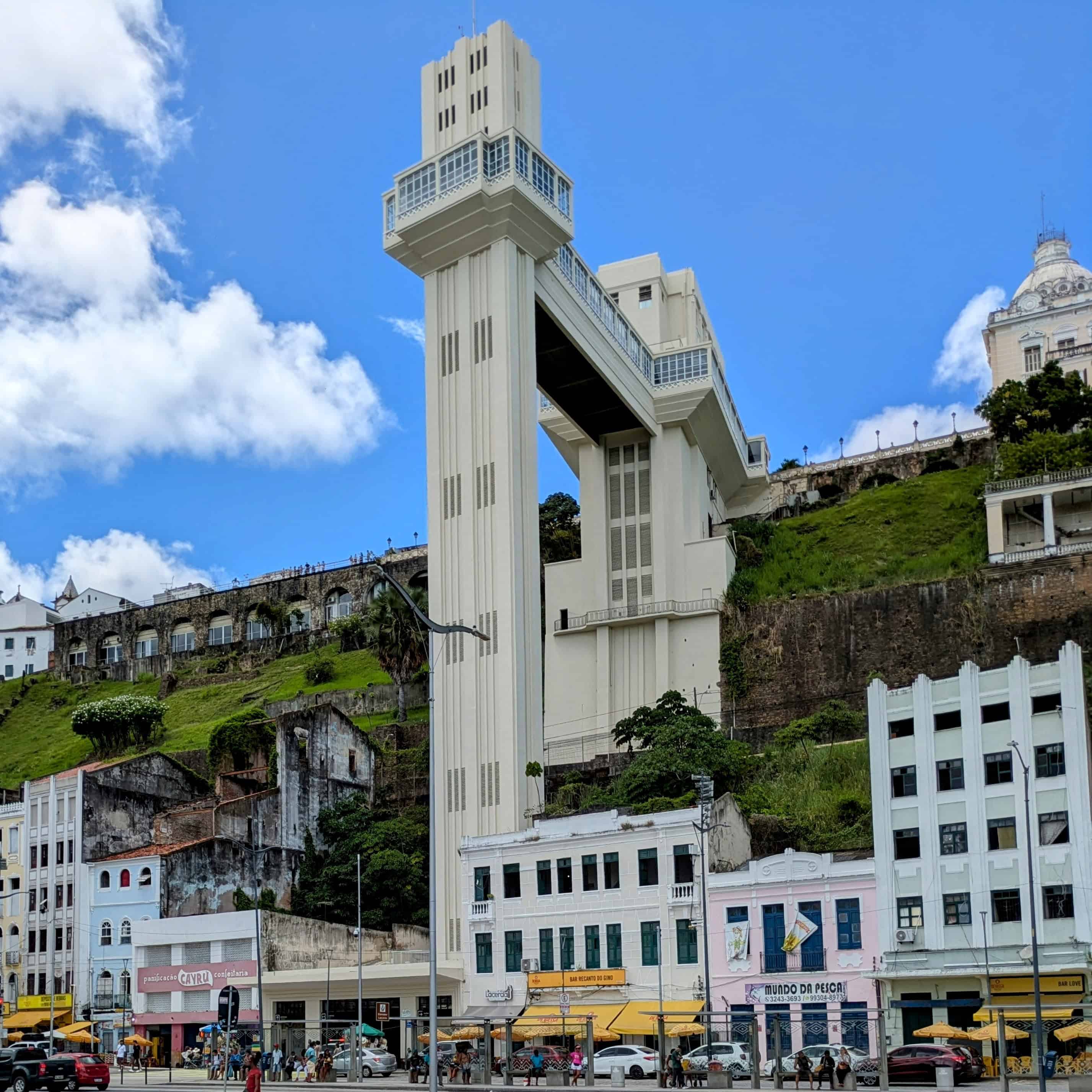
16. Elevador Lacerda

This is one of several public elevators connecting the upper and lower cities. This one costs R$0.15 to ride if there happens to be someone taking tickts.
Ride it down to the lower city for the last few stops on your Salvador de Bahía walking tour.
17. Monumento à Cidade de Salvador – BA

This colossal fiberglass fountain was commissioned to pay homage to the city of Salvador, and it has become a symbol beloved by its inhabitants and visitors alike. What it represents is one of the great mysteries of life, perhaps best left unsolved.
18. Mercado Modelo


A building of considerable commerce and, one might argue, a disquieting amount of trinkets, stands as a testament to the human desire to acquire things. Once a customs house where slaves were housed when they arrived in Salvador, it now serves as a labyrinthine marketplace. Though seemingly a place of harmless commerce, one cannot shake the feeling that within its bustling corridors, secrets and perhaps even a few unfortunate bargains await the unwary visitor.
Head out the back door of the market to the final stop on our Salvador de Bahía walking tour.
19. Arena da capoeira

The Arena da Capoeira is a monument and cultural space that serves as a vibrant tribute to capoeira, recognizing its importance as an Afro-Brazilian cultural expression combining martial arts, dance, and music. Specifically, it’s made up of four steel arches, 12 meters high, representing berimbaus (the main instrument in capoeira music) joining at the top; and ten bronze sculptures, honoring great capoeira masters from Bahia.
I’m sure you’ve enjoyed this Salvador walking tour. If you’re looking for more, here are all of my posts about Salvador de Bahía and Brazil, including tips for planning your trip and essential Brazil travel experiences.


Leave a Reply