Salvador was once deemed important enough to be the very first capital of Brazil. Imagine that: the first. And for centuries, Salvador was a bustling hub, a place where ships arrived laden with goods and, regrettably, with people snatched from distant lands. This history has left an indelible mark, shaping its culture, its music, and even the very flavours that waft from its kitchens. So should you be the sort of person who finds a peculiar interest in such historical murmurings and cultural comminglings, you might just find yourself with a list of things to do that is… well, let us simply say, not inconsiderable. Here are the best things to do on a visit to Salvador, Brazil.
Here’s my Google Map of the best things to do in and around Salvador. Hit the “Follow” or “Save” button to save for later.
This post contains affiliate links and I may earn a small commission when you make a purchase using the links at no additional cost to you.
If this is your first stop in Brazil, read my 13 tips for planning a trip to Brazil.
Best Things to See and Do in Salvador
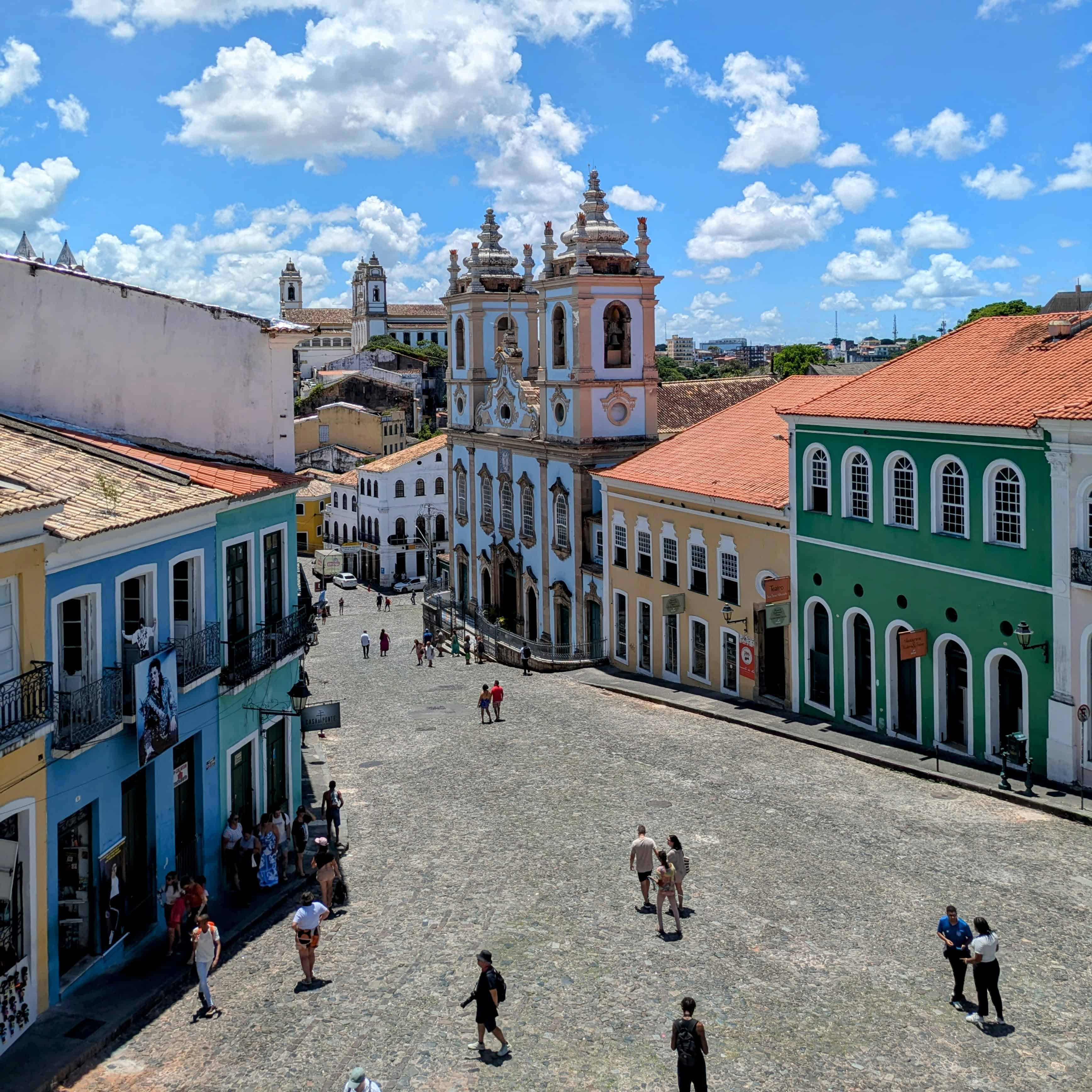
- Visit Largo do Pelourinho: This triangular cobblestone plaza, once a site for punishing enslaved people was transformed after the abolition of slavery in 1835. It fell into disrepair but was restored in the 1990s to its former glory so much so that it became the set of a Michael Jackson music video. Today, it stands as a vibrant symbol of Salvador’s resilience, where the shadows of the past are overshadowed by the lively atmosphere enjoyed by tourists and locals alike.


- Visit Fundação Casa de Jorge Amado: A once-residential building now a repository of literary legacy, houses the remnants of Jorge Amado’s life and works, a writer known for his peculiar observations of the world. This blue-facaded house preserves his writings, letters, and accumulated papers, offering exhibitions that reveal tales of his creations and life. Don’t miss the hidden basement exhibit. Regular admission is R$20 or free on Wednesday.


- Visit the Igreja Nossa Senhora do Rosário dos Pretos: A periwinkle church of remarkable history, the land a gift from the king of Portugal, built by enslaved African men, and consecrated in 1796 after decades of labor. Its simple facade belies an interior adorned with depictions of Black saints, a gilded altar, and a carved choir, all echoing the resilience of its builders. Known for its Afro-Brazilian religious services with drums and Yoruba chants, it remains a vital cultural and spiritual center for the Afro-Brazilian community.


- Attempt to learn the rhythmic complexities of Samba or try Capoeira, a martial art involving flips and kicks and other such displays of agility.
- People watch in Terreiro de Jesus Square: This place of cobbled stones and a certain bustling unease, is a gathering point where the past and present collide with a clatter. Here, one finds a confluence of vendors, musicians, capoeiristas, and tourists, all moving with a peculiar sense of purpose, or perhaps aimlessness. The square, surrounded by churches and historical buildings, holds a history of religious celebrations. While seemingly a place of lively commerce and cultural display, one cannot shake the feeling that beneath the surface, a more complex and perhaps slightly unsettling narrative unfolds.


- Visit Catedral Basilica: A rather imposing structure erected by the Jesuits, stands in the city’s heart, a monument to time and ambition. Its lengthy construction, begun in the late 16th century, yielded a stone facade with towering features and a simple yet elegant interior filled with ornate religious art, creating an atmosphere of overwhelming scale. Witness to centuries of history, the cathedral has endured renovations and restorations, remaining a central religious landmark where countless individuals have sought solace or ceremony.


- Visit the Casa do Carnaval da Bahia Museum: A place of vibrant costumes and rhythmic echoes that stands as a curious testament to the city’s celebrated, and often bewildering, Carnival. Within its walls, one finds an array of glittering garments, peculiar masks, and recordings of delightful music. This museum, a repository of sequins and drumbeats, displays the history and traditions of Carnival, which, like many things in life, is both dazzling and, upon closer inspection, rather perplexing. Regular admission is R$20.


- Explore history at the Museu Afro-Brasileiro: This museum contains one of Bahia’s most important collections of objects related to the history and culture of Afro-Brazilians. Objects of wood, pottery, metal, and cloth, arranged with a certain order. Downstairs is the Museu de Arqueologia e Etnologia Museum, where one encounters relics of curious provenance – ancient tools, enigmatic artifacts, and ethnographic specimens – each a fragment of a indigenous Brazilian story left untold, or perhaps, poorly told. This is a place where the past, like a persistent cough, refuses to be silenced. Regular admission is R$10 and grants you admission to both museums.

- Admire the Igreja e Convento São Francisco: This magnificent building of considerable ornamentation was completed in 1723. Its interior is reported to be a spectacle of gold leaf and carved wood, a display of enthusiastic wealth and splendor that is, perhaps, best viewed with a sense of perspective. The walls, covered in azulejo tiles, depict scenes of… narrative complexity. And an 80 kg silver chandelier dangles over it all. Too bad it was closed for restoration when we visited.

- Haggle at Mercado Modelo: A building of considerable commerce and, one might argue, a disquieting amount of trinkets, stands as a testament to the human desire to acquire things. Once a customs house where slaves were housed when they arrived in Salvador, it now serves as a labyrinthine marketplace. Though seemingly a place of harmless commerce, one cannot shake the feeling that within its bustling corridors, secrets and perhaps even a few unfortunate bargains await the unwary visitor.


- Visit Solar do Unhão: A place of curious juxtapositions and unsettling silences presents itself as an 18th-century manor that has undergone a rather transformative experience. Once used as a transfer point for sugar shipments, it now houses a collection of modern art with a hillside sculpture garden. The echoes of murdered slaves mingle with the stark lines of modern design, a pairing that, while undoubtedly intentional, evokes a sense of unease. Enjoy Saturday evening jazz and bossa nova concerts (JAM no MAM) while taking in the stunning views of the bay. Use caution when traveling to the concert, as the area is known for tourist muggings, and consider taking a taxi. Regular admission is free.


- Eat!: Be sure to at least try moqueca and acarajé. If you’re looking for more, here’s my full list of foods to seek out and places to eat and drink in Salvador.


- Get some fitinhas from Igreja Nossa Senhora do Bonfim: A church of such purported sanctity that one might suspect a little cachaça has been added to the holy water. This edifice, draped in fitinhas (ribbons of every conceivable hue) is said to possess miraculous powers. One approaches it with a sense of trepidation, not unlike that experienced when encountering a particularly enthusiastic street vendor offering suspiciously cheap acarajé. Regular admission is free.
In Candomblé (an Afro-Brazilian religion popular in Salvador), Nosso Senhor do Bonfim (Our Lord of the Good End) is syncretized with Oxalá, the highest deity in the Candomblé pantheon. This blending of faiths makes this church a crucial spiritual site for many people. Pilgrims arrive in droves, their faces a mixture of fervent belief and the sort of bewildered exhaustion one might expect from a long journey involving unreliable transportation and questionable snacks.
Pilgrims acquire fitinhas, often from vendors who seem to materialize from thin air, and then tie them to their wrists. It is said that making three knots, and then making a wish for each knot, will bring about a favorable, if perhaps slightly delayed, outcome. One then waits for the ribbon to fall off naturally, at which point, one hopes, the wishes will be granted.


- Browse Feira de São Joaquim: A sprawling collection of stalls, each brimming with an astonishing array of goods. There are fruits and peppers of vibrant hues, bottles of potions promising to solve any number of problems, and all manner of objects, the purpose of which some might struggle to identify.


- Visit Forte de Santo António da Barra: One might approach this bastion, built in 1698 and perched precariously on the edge of Salvador, with a sense of hopeful anticipation, only to find the cannons, like forgotten cutlery, rusting in the salty air. The lighthouse is South America’s oldest, a solitary eye blinking warnings into the vast, indifferent ocean. And within its walls, one will find a nautical museum showcasing displays from the days of Portuguese seafaring and slave trade. One can almost hear the echoes of countless, mildly disappointing sieges. Regular admission is R$20.


Take a look! This article is now featured on GPSmyCity. To download this article for offline reading or create a self-guided walking tour to visit the attractions highlighted in this article, go to Walking Tours and Articles in Salvador.
I hope this list of the best things to see and do in Salvador de Bahía did not put you to sleep. If you want more, here’s everything I’ve written about Brazil.


Leave a Reply