Catania is a city located at the foot of Mount Etna, a volatile and unpredictable volcano that looms over the city like a looming threat. The streets are lined with Baroque architecture, but the buildings seem to be sinking into the ground, and the roads are in a constant state of disrepair. The locals are known for their fiery tempers and their love of seafood, which can be found in abundance at the city’s lively fish market. But be warned – one wrong move and you may find yourself in the midst of a heated argument or caught in the crosshairs of an erupting volcano.
Catania’s historic center is fairly compact with the exception of a couple of sights. If you have a full day and a good pair of walking shoes, you should easily be able to see all of them but you could also split the tour in half if you want more time for leisurely meals.
Read on for a free self-guided walking tour that you can do on your own time, using my outline. I’m including a Google Maps link for each of the stops to help you follow along and also so that if you want to enter any of the sites, you’ll be able to see when they’re open.
Don’t miss out on this! This article is also featured on GPSmyCity. To download this article for offline reading or create a self-guided walking tour to visit the attractions highlighted in this article, go to Walking Tours and Articles in Catania.
This post contains affiliate links, and I may earn a small commission when you make a purchase using the links at no additional cost to you.
Where to Start
Here’s more information about how to get to Catania getting around Catania, where to stay, where to eat, and what else to do in Catania.
Once you’ve made it to Catania, dropped off your luggage, and maybe had a good sleep and/or something to eat, make your way to Porta Uzeda to officially start your tour.
1. Porta Uzeda
Porta Uzeda is an old city gate built in 1696 to connect Via Etnea to Catania’s port.
2. Catania Fish Market

This workday fish market is pure street theater full of colour and movement. Try to go before noon and look for swordfish, prawns, and trays full of clams, mussels, sea urchins, and all manner of less familiar sea life. There are also plenty of restaurants cooking up fresh seafood where you can sit and enjoy the atmosphere.
- Hungry? Try L’ISKA for sit-down seafood on a cute street, Scirocco Sicilian Fish Lab for freshly caught and fried seafood in paper cones, or Vuciata for typical Sicilian food on a nice terrace.
3. Fontana dell’Amenano

The water from this 19th century fountain flows into an underground river.
4. Piazza del Duomo and Fountain of the Elephant

Piazza del Duomo is the main city square in Catania. It’s a UNESCO World Heritage Site and home to some of the city’s most notable historic buildings.

The elephant is said to protect Catania from Etna’s violent eruptions.
5. Catania Cathedral

Basilica Cattedrale di Sant’Agata has been destroyed and rebuilt several times because of earthquakes and eruptions of Mount Etna. It was most recently rebuilt in the Baroque style after the 1693 earthquake.

6. Chiesa della Badia di Sant’Agata
Visit the dome for views of Mount Etna if the sky is clear. Admission to the church is free and it is €5 to climb to the dome.


7. Palazzo Biscari
This opulent private palace built in the 1600s is open for guided tours only. While inside, take a peek at the gorgeous courtyard before heading to see the grand hall, hand-painted frescoes and the most beautiful staircase. Currently open for 30 minute guided tours Tuesday-Friday from 10am to 1pm unless there happens to be a private event. Tours cost €10.
- Hungry? Try Ristorante Canni & Pisci serves excellent fish and meat dishes popular with locals.
8. Teatro Massimo Bellini

This theater opened in 1890 with the Opera ‘Norma’. It’s open for guided tours Tuesday through Saturday, from 9am to 12pm.
- Hungry? Try Nuova Trattoria del Forestiero for Catania’s signature dish, pasta alla Norma, named after the opera.
9. Basilica della Collegiata

A baroque church that is free to visit, but closed for much of the afternoon.
- Hungry? Try Ristorante Il Bell’Antonio for great fish and seafood dishes, Razmataz to sample some local Etna wines, Me Cumpari Turiddu for Catania’s specialty, pasta alla Norma, or Trattoria del Cavaliere to try another local specialty, horse meat.
11. Villa Bellini

This is an optional stop and if you choose to include it, I suggest taking a scooter (Lime, Helbiz, Dott).

Villa Bellini is the largest and oldest public green space in Catania. Adorned with busts of various Catanese musicians, writers, and politicians.
- Hungry? Try Curtigghiu for traditional Sicilian food in a cozy side street or Pasticceria Savia to get a gelato, granita, or pastry to enjoy while wandering through Villa Bellini.
12. Church of San Nicolò l’Arena

Climb to the roof for amazing views of the historic center. The construction of this church begun in 1687 but the facade was never finished. The church interior features a display of large Baroque candelabra that are carried through the streets during the feasts of Sant’Agata in February. The church is free to visit and the fee to climb to the roof is €3.
13. Monastery of San Nicolò l’Arena

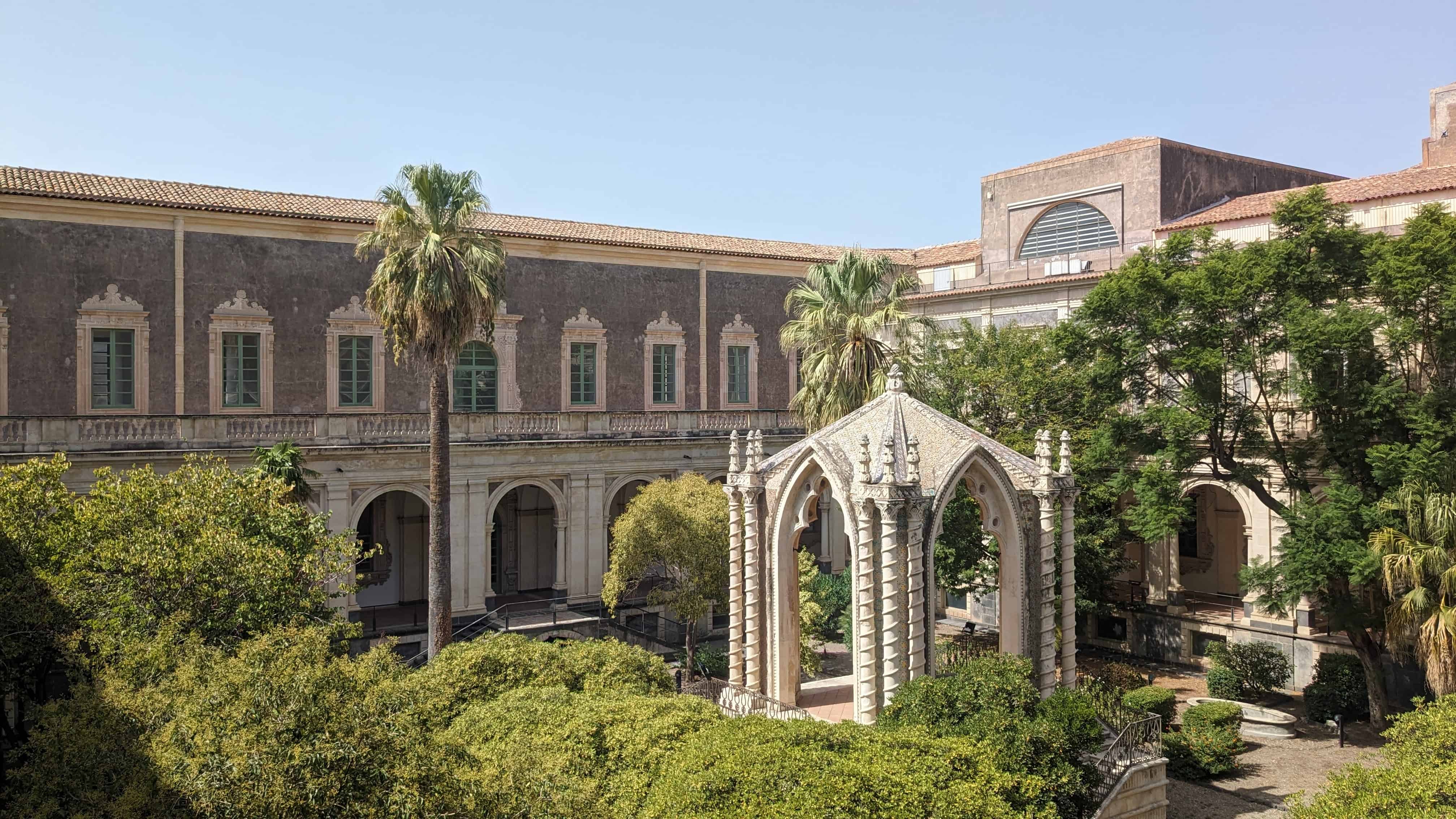
A UNESCO World Heritage Site, one of the largest monasteries in Europe, and an example of late Sicilian Baroque architecture. Built in the 1500s but modified due to lava flow in 1669 and an earthquake in 1693.

Expect a grand staircase, long corridors, peaceful cloisters, a garden built on lava, and magnificently bitchy librarians.

Explore or your own or join an English language guided tour daily at 1pm or 4:30pm.
14. Archaeological Complex Terme della Rotonda

This is temporarily closed but you can sneak peeks of the exterior of this Byzantine church build on top of Roman baths.
15. Via Crociferi

Built in the 18th century, this city centre street lined by imposing Baroque churches, grand villas (and their accompanying gardens) is considered a symbol of the Sicilian Baroque architectural style in Catania.
Pass through the Arco di San Benedetto on your way to the Greek-Roman Theater.
16. Greek-Roman Theater

The Roman Theater was built in the 1st century CE over an existing Greek structure which dates from the 5th to 4th century BCE. The theatre was designed to accommodate about 7000 spectators in a semi-circle. After the end of the Roman Empire, much of the marble that decorated the theater was used to construct the Cattedrale di Sant’Agata, and other buildings were constructed over it.

Excavation of the site began in the late 1700s and it is now used for occasional summer performances. There is also an Odeon on the site, with a capacity of about 1500 spectators. Regular admission is €6 as of September 2023.
17. Castello Ursino

When this castle was built in the 13th century, it was overlooking the sea. The 1669 lava flow changed the landscape so drastically that the castle is now landlocked. It now houses the Museo Civico.

Expect archeological treasures and an extensive collection of paintings, vases, sculptures, and coins. There is also a small collection of fascinating historical pieces depicting Catania through the ages. Regular admission is €11 as of September 2023 and comes with a free audioguide.
- Hungry? Try Ristorante da Antonio for traditional Sicilian dishes, seafood, and pasta in a cozy tratoria.
18. Porta Garibaldi
This is another optional stop and I encourage you to take a scooter if you decide to check it out (Lime, Helbiz, Dott).

Porta Garibaldi was constructed in the 1700s as a triumphal arch in the very centre of Catania. Look through it and 1.3 kilometers down Via Giuseppe Garibaldi and you’ll see the Duomo of Catania.
This concludes our Catania walking tour so now’s a good time to think about what sights you might want to return to. If you’re looking for more, here are all of my posts about Italy.


Leave a Reply